

It’s a phrase we’ve been hearing for years, on the phone and in the comments on our posts:
“It’s getting hotter and hotter. Why do you want me to build a greenhouse?”
Someone asked us on 26 June. That week, the UK broke its June temperature record on three consecutive days, and the Met Office issued a Red Extreme Heat Warning for three days running — the first time that has happened since the warning was introduced in 2021.
The question was the same as always. It just sounded very different.
Because at that exact moment, in tens of thousands of gardens, something quiet was happening. Perfectly healthy tomato plants, properly watered, covered in flowers a few days earlier, were dropping those flowers one by one. No disease. No pest. No gardening mistake.
What Happened to the Seedlings
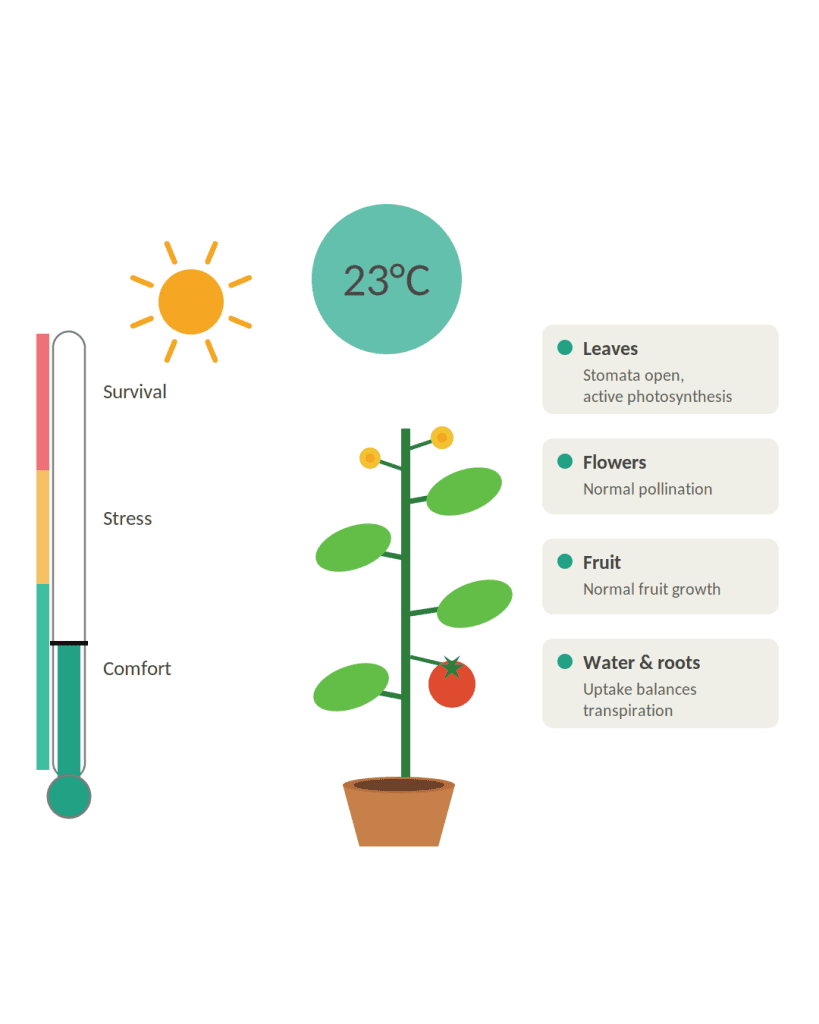
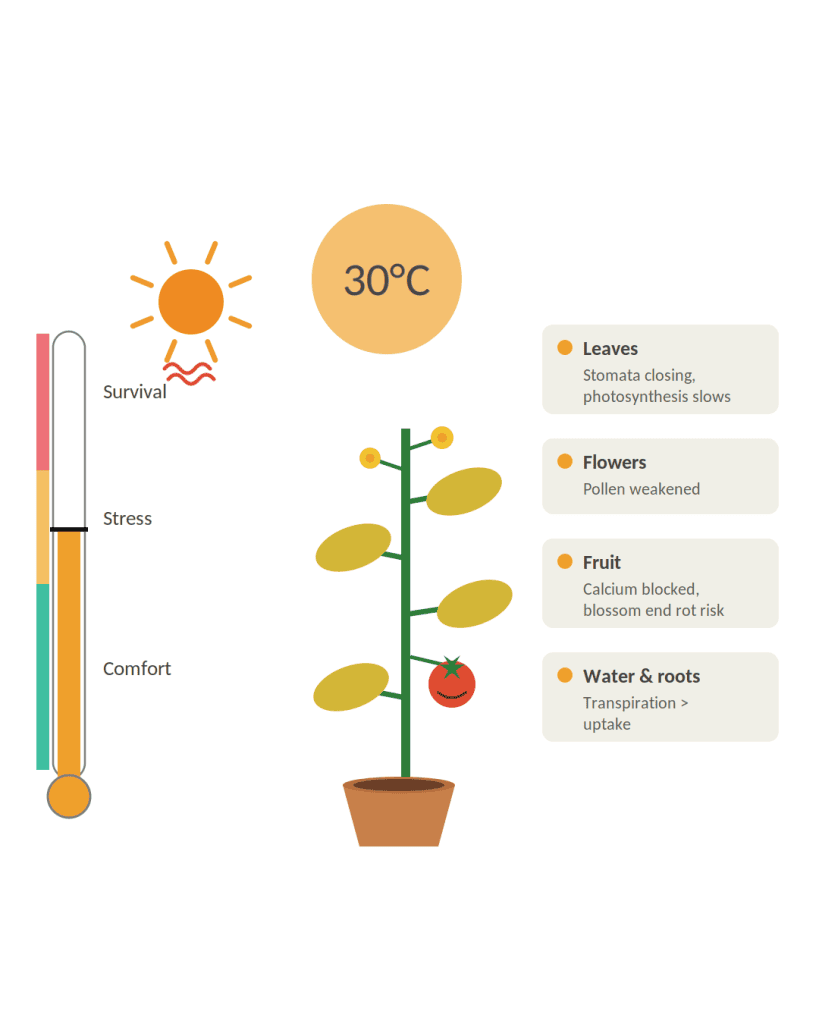
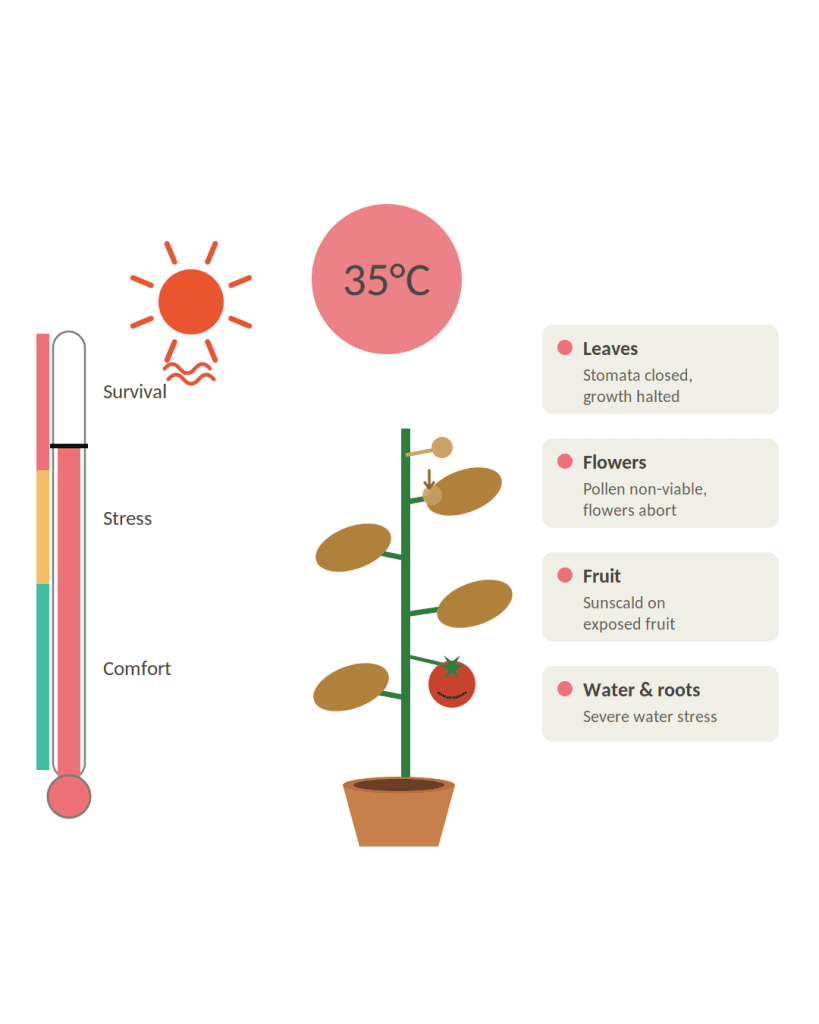
A plant doesn’t suffer from heat the way we do. It stops.
Above 30°C, a tomato stops producing the pigment that turns it red. Above 32°C, its flowers begin to abort. At around 34°C, its pollen becomes sterile: the flower opens, but no fruit can ever form.
And there’s a final threshold, the one nobody watches. If the night doesn’t drop below 24°C, the plant doesn’t recover. The following day can be perfect — it changes nothing.
Now think back to the last week of June. Cardiff recorded an overnight low of 23.5°C, a UK record, against a previous high of 20.0°C set in 2023. Hastings didn’t drop below 23.2°C. More than 150 weather stations set new June maximum records, and a similar number set records for their warmest June night — including sites with over a century of data.
Across much of western Europe, the picture was the same. Germany broke its all-time national temperature record with 41.7°C at Coschen on 28 June, and 252 German weather stations recorded their highest temperature ever.
For a great many gardens, this meant one thing: for well over a week, outdoor tomatoes simply stopped producing. No amount of watering or mulching would have changed that. It had stopped being a question of gardening and become a question of plant physiology.
And the hot air wasn’t even the worst of it. Direct sun scorches. A single afternoon is enough to permanently damage fruit and foliage.
Many of our Pioneers grow both under glass and in the open ground, a few metres apart. By late June, the difference was no longer a matter of yield. On one side of the path, the harvest carried on. On the other, it was over.
This June was not a one-off
It’s tempting to file June 2026 under “exceptional year” and move on. The problem is that the exceptions now arrive every year.
The figures leave little room for interpretation. Western Europe recorded its warmest June ever, at 20.74°C — more than 3°C above the 1991–2020 average, and beating the record set only twelve months earlier, in June 2025. England recorded its warmest June since records began in 1884. And this heatwave followed an unusually intense one in May, with another building in early July.
That last detail matters more than the records. The risk season isn’t shifting later in the calendar. It’s getting longer.
Behind it sits a mechanism that is no longer disputed. The Copernicus Climate Change Service describes a climate system that keeps accumulating heat, producing increasingly intense heatwaves and a persistently warm ocean — with growing risks for people, ecosystems and infrastructure. Europe is the fastest-warming continent on Earth. And according to the World Weather Attribution research group, a heatwave of this kind would have been practically impossible fifty years ago; the same weather pattern would then have delivered temperatures roughly 3.5°C cooler.
None of this is a pessimistic forecast. It’s a decision about equipment.
“But a greenhouse gets hot!”
That’s a valid point. If you associate “greenhouse” with “greenhouse effect,” installing one during a heat wave seems like a bad joke.
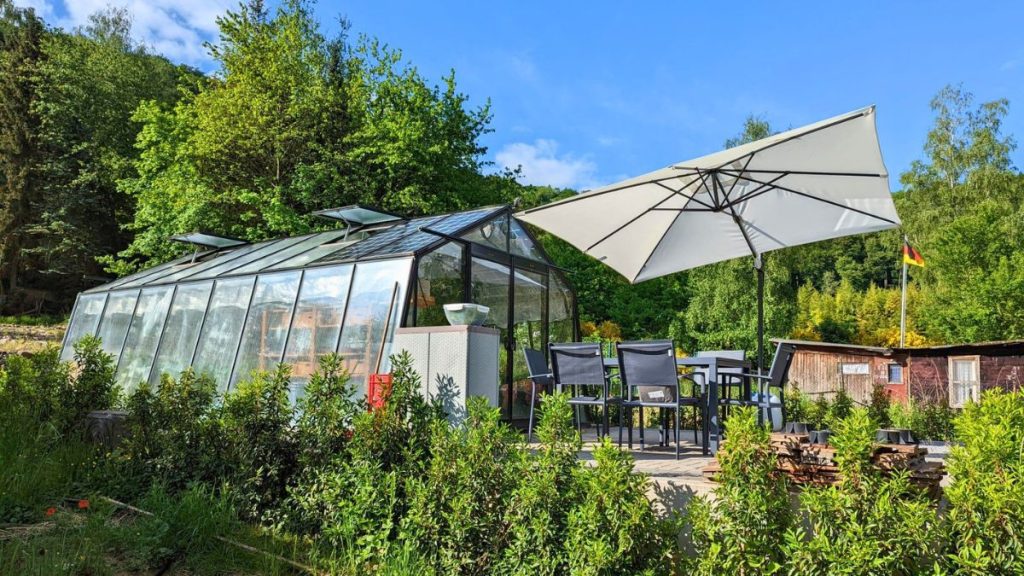
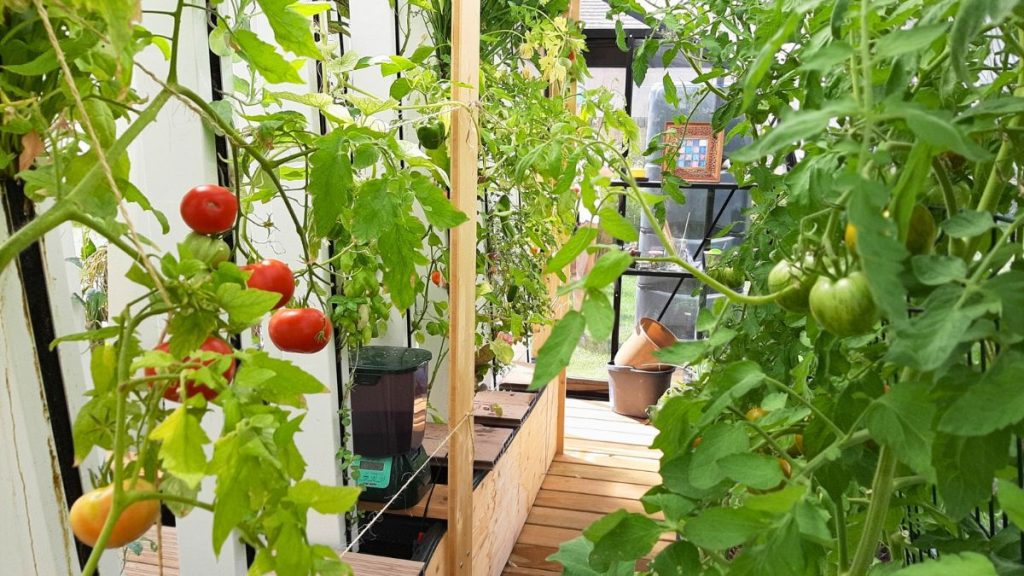
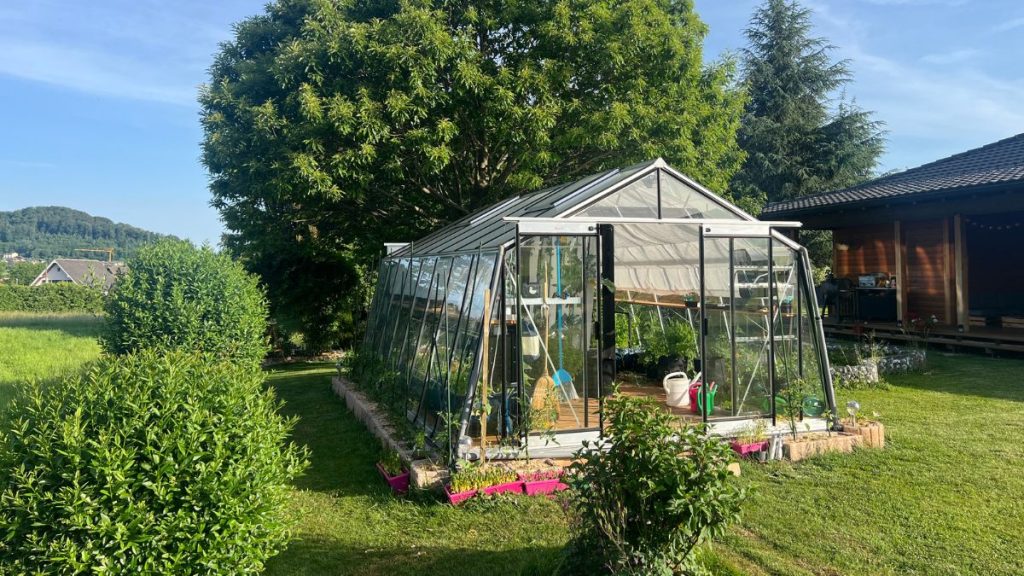
Except that not all greenhouses are the same. A closed plastic tunnel does indeed turn into an oven. A bioclimatic greenhouse isn’t designed to trap heat during a heat wave— it’s designed to regulate it.
The principle consists of three ideas.
Hot air rises, so we let it escape. Skylights on the greenhouse roof open automatically as the temperature rises, using a simple gas spring—no electricity required. The front and rear doors create a draft. Warm air is vented out instead of building up.
Volume acts as a buffer. The taller a greenhouse is, the more the air mass inside it helps smooth out temperature fluctuations. That’s why commercial greenhouses are sometimes as tall as twelve meters. It’s not about space—it’s about keeping the air cool.
We block the sun, not the light. That’s the point almost no one realizes: it’s not the hot air that burns your fruit—it’s direct sunlight. A shade cloth blocks this sunlight while letting through what the plant needs to grow.
The result is always surprising: during the hottest part of the day, it’s cooler inside a well-equipped greenhouse than outside.
If that seems implausible to you, here’s a question: Why are square kilometers of greenhouses being built in Andalusia, Tunisia, and the United Arab Emirates? Certainly not to keep crops warm. In those climates, a greenhouse isn’t a luxury—it’s a tool for survival.
What a Myfood greenhouse offers
The water works for you. In an aquaponic or bioponic greenhouse, several hundred litres circulate continuously. That mass of water absorbs heat during the day and releases it slowly at night. The growing system doesn’t merely endure the greenhouse climate — it helps hold it steady.
And crucially, the water isn’t lost. This is the most misunderstood difference between an open bed and a closed loop. When you water at 35°C, a significant share of that water never reaches the roots: it evaporates from the soil surface, runs off, or drains below the root zone. The hotter it gets, the greater the loss — at precisely the moment the plant needs it most.
In a Myfood greenhouse, the water travels in a loop. It flows from the basins to the vertical growing towers, keeps the roots continuously moist, and returns to the basins. Whatever the plants don’t take up isn’t wasted — it goes round again. You’re no longer watering a surface and hoping it soaks down: you’re feeding the roots directly, all day, without swings.
The benefit is twofold. Crops no longer experience the drought-and-drench cycle that stresses plants in open ground, and seasonal water consumption sits in an entirely different bracket from a conventional bed of the same area.
June showed exactly how much that matters. Much of western continental Europe and southern England saw drier-than-average conditions, on top of soils that were already drying out after May’s heatwave. When hosepipe bans arrive, a closed loop keeps running.
You know what’s happening, in real time. During a heatwave, everything turns on a few hours. Sensors that track air and water temperature and alert you before a critical threshold is crossed are worth rather more than a thermometer you check when you get home in the evening.
One condition remains, and we’d rather state it plainly: a greenhouse only protects against heat if it is equipped for summer. Automatic ridge vents, double doors, an extractor fan, shade cloth, shade panels over the basins, a misting system. These are what turn an oven into a shelter.
Warming won’t hand you a Mediterranean climate
The last objection, and the most expensive one: “it’s getting warmer, so soon I’ll be able to grow outdoors all year.”
Warming doesn’t move your garden south. It makes it unpredictable. A heatwave in May. A late frost on buds that broke too early. A hailstorm that flattens a plot in ten minutes. A rainless summer followed by a drowned autumn.
A plant never dies of an annual average. It dies of an extreme. And a greenhouse, in the end, does only one thing: it filters extremes.
Conclusion
In 2023 we wrote on this blog that a greenhouse was becoming a necessity. Three summers on, the sentence needs correcting: it has become one.
Heatwaves are not going to grow rarer. Every summer ahead will, statistically, be harder than the one before.
So let’s return to the question we started with. Why install a greenhouse when it keeps getting hotter?
Because it keeps getting hotter. Those fallen flowers in June weren’t a seasonal accident. They were a preview.
Anyone equipping their garden today isn’t protecting themselves against one summer.
They’re equipping themselves for the twenty that follow.
Want to talk about it?
Talk to a Myfood advisor about your project
Discover Myfood Greenhouses · Get My Greenhouse Ready for Summer · The Guide to Heat Waves